
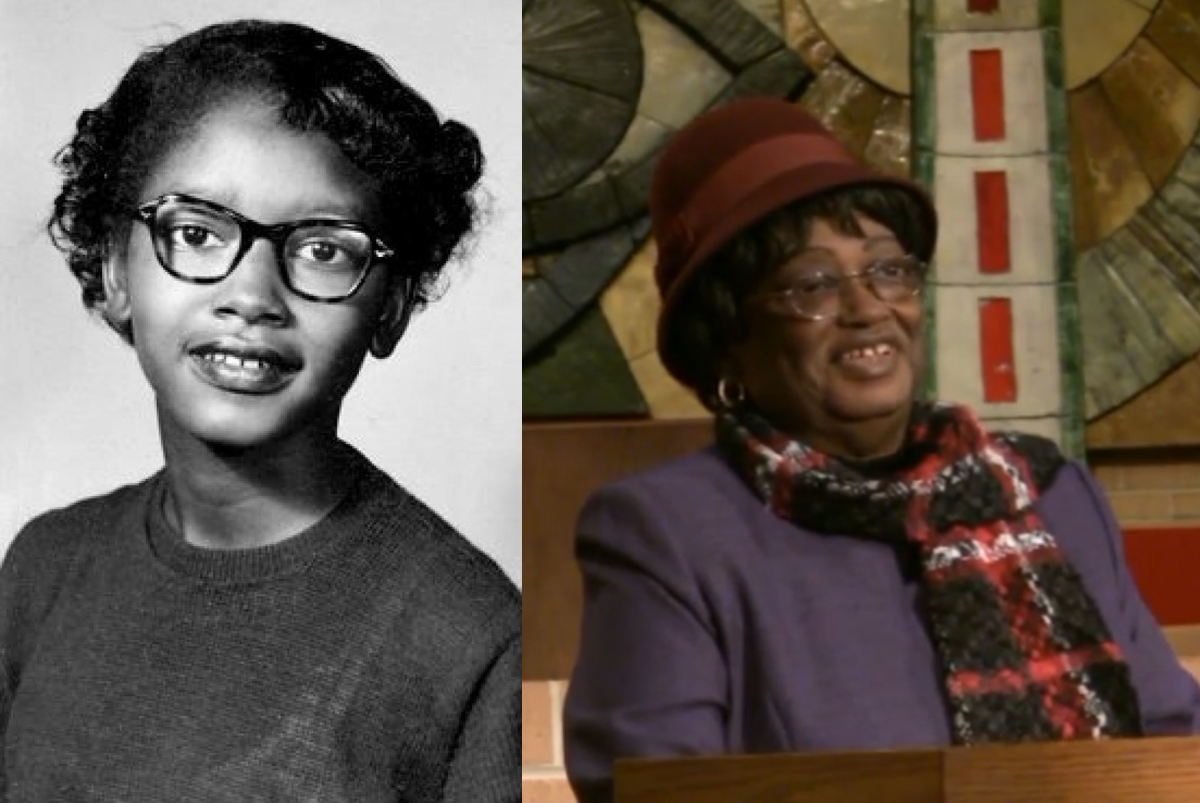
Most Americans have heard about Rosa Parks, but did you know that before Parks refused to get out of her seat, there were other brave Black women who refused to give up their seats on segregated buses? Each of their actions played an important part in securing equal rights for all during the Civil Rights Movement. One of them, Claudette Colvin, was only 15 years old when her courage and smarts inspired a (successful!) movement to desegregate buses.
Claudette Colvin recently passed away at age 86, so this Black History Month is a fitting time to honor her life by learning her story and sharing it with your family. The following is a simple way to explain to kids (or to anyone) what she did and why it made a difference. It’s a relatable story that you can tell when you’re waiting at the bus stop or when you see protests in the news, or that you can remind yourself of the next time your child is acting “strong willed.”
For more details about Claudette Colvin’s life, be sure to read Claudette Colvin: I Want Freedom Now! (for ages 4 and up) or Claudette Colvin: Twice Toward Justice (for ages 12 and up).
The story of Claudette Colvin
It was just a regular Wednesday on the way home from school, when this 15-year-old’s courage and persistence sparked a movement.
On March 2, 1955, Claudette Colvin was riding a crowded bus in Montgomery, Alabama, with three other Black schoolmates. They were all told to move so that a white woman could have the whole row to herself — which was normal and expected at the time.
But that day, Claudette held on to her rights as a human being and refused to get up. She had been learning about anti-slavery abolitionists in school, and felt like she had Harriet Tubman on one shoulder and Sojourner Truth on the other — history had her “glued to the seat.” The police dragged her off the bus and arrested her.
Claudette and a few other Black women who had been arrested in these incidents ended up inspiring Rosa Parks and the Montgomery Bus Boycott. As Claudette Colvin’s and Rosa Parks’ former attorney, Fred Gray, said, “Claudette gave all of us moral courage. If she had not done what she did, I am not sure that we would have been able to mount the support for Mrs. Parks.”
For an entire year, tens of thousands of Black bus riders decided to walk or carpool, so they could boycott the bus system to bring attention to the segregation practices. At the same time, Claudette was showing up in court as a plaintiff in a case that went all the way to the U.S. Supreme Court. Finally, the courts decided that segregation on buses was unconstitutional!
The Montgomery bus system became integrated, and the boycott ended after 381 days. The Montgomery Bus Boycott ended up setting an example for many other effective, nonviolent mass protests that would change the course of history.