
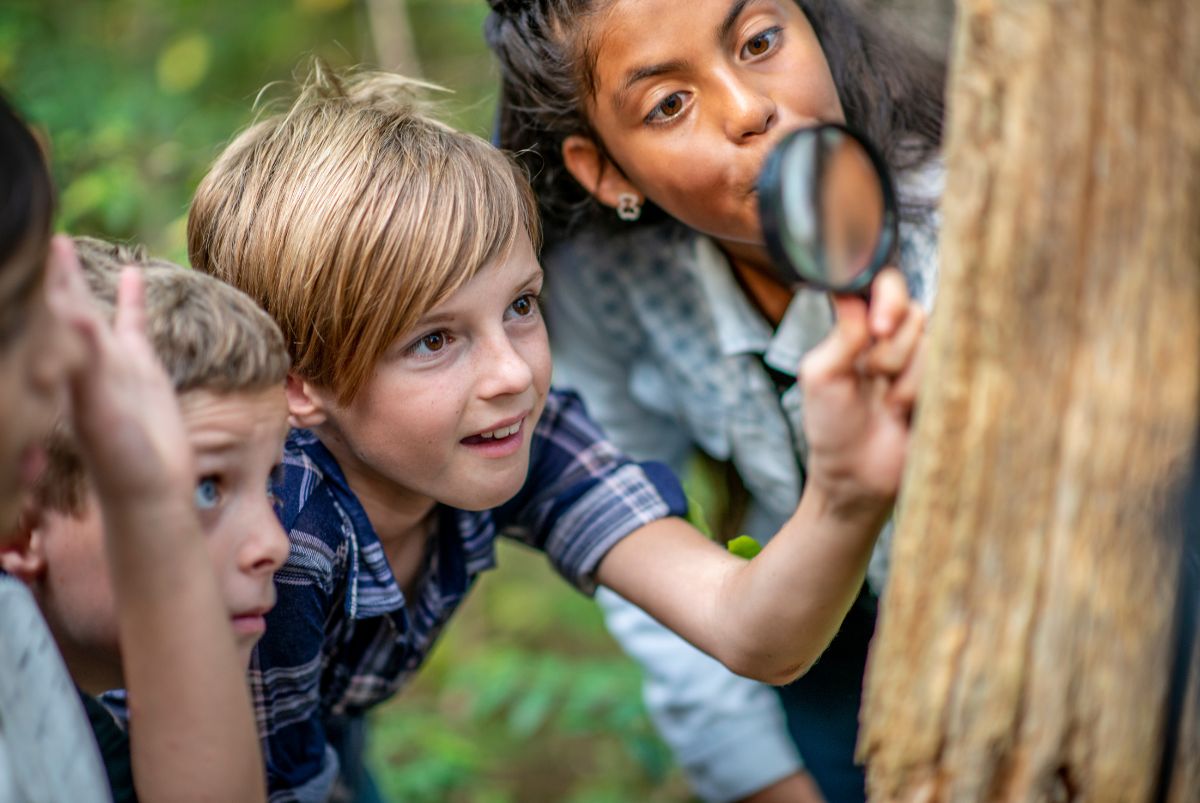
Children do not need laboratories, white coats, or advanced degrees to make real scientific discoveries. What they need, and what they already have, is the habit of paying attention.
Long before science becomes a school subject, it begins as a way of moving through the world: noticing patterns, asking why, testing ideas, and adjusting when something does not work. Children excel at this. They watch closely because they are not yet burdened by assumptions about what matters or what is “worth noticing.” Their curiosity is unfiltered. Their questions are sincere. Their attention lingers.
These qualities are not accidental. They are the foundation of scientific thinking: observation, patience, adaptability, and resilience. Children experiment constantly. They stack objects to see what falls, mix substances to see what changes, and watch animals to learn what happens next. To them, mistakes are not failures; they are information. This mindset fuels discovery.
Adults often assume science is something children grow into later, after enough instruction. In reality, children can grow out of scientific thinking when curiosity is rushed or discouraged. When answers arrive too quickly, when efficiency replaces exploration, or when questions are treated as distractions, the habit of close observation weakens. Yet when children are given time, simple tools, and encouragement to look carefully, remarkable things happen.
Parents play a quiet but critical role. You do not need to teach formal science to nurture scientific minds. You can model curiosity, slow the pace, and value questions more than answers. The stories that follow show just how far that simple habit can take a child.
Young observers, real discoveries
The power of careful observation is not theoretical. Again and again, children who simply paid attention have made contributions that changed how scientists understand the world.
At age ten, Rehan Somaweera noticed something subtle while snorkeling with his father: a small fish repeatedly shadowing an octopus. Adults had seen both animals countless times, but no one had lingered on their interaction. Rehan did. Through repeated observations, he documented that the fish fed on prey disturbed by the octopus—a relationship known as “nuclear-follower” behavior. His careful field notes led to a peer-reviewed scientific paper, making him the youngest published scientific author in Australia.
Sixteen-year-old Sahithi Pingali began with a troubling sight close to home. Lakes in her city of Bengaluru were foaming and, in some cases, catching fire due to industrial pollution. Rather than assuming the problem was beyond her reach, she designed a low-cost water-quality sensor that allowed residents to measure and upload real-time data. What began as local observation became a community science project, later presented at an international science competition and developed further with university researchers. Her work shows how noticing a problem—and refusing to look away—can lead to systemic change.
In Hildesheim, Germany, a class of eleven- and twelve-year-olds noticed that bees seemed to favor certain flowers on their school grounds. With guidance from their teacher, the students designed controlled experiments to test whether bees preferred flowers with ultraviolet markings invisible to humans but visible to insects. Their results were rigorous enough to be published in a scientific journal, offering a striking example of how children’s questions, when taken seriously, can meet professional standards.
Emily Rosa, at age eleven, turned her curiosity toward a popular medical claim. Using a simple but carefully controlled experiment, she tested whether practitioners of “Therapeutic Touch” could actually detect human energy fields. They could not. Her study was published in a leading medical journal and sparked widespread debate, demonstrating that clear thinking and good experimental design matter more than age or authority.
Ten-year-old Kathryn Aurora Gray made her discovery far from Earth. By carefully analyzing astronomical images, she identified a previously unknown supernova. The finding was confirmed by professional astronomers, making her the youngest person ever to discover one. Her contribution added meaningful data to the scientific record and highlighted the value of patient, attentive observation.
Letting curiosity do its work
These children did not set out to make headlines or prove anything extraordinary. They noticed something small, stayed with it, and followed their curiosity where it led. Their stories remind us that the habits behind scientific discovery—paying attention, asking questions, noticing patterns—are already present in many children.
When adults make room for those habits to flourish, children gain more than knowledge. They gain confidence in their own perceptions, resilience in the face of uncertainty, and a sense that the world is something they can understand and contribute to. Science begins not with answers, but with attention. Children are ready for that work. The rest is permission.